
White Spot (Ich) in Koi: Life Cycle, Symptoms and Treatment
Educational guide · References and further reading below. Seek qualified advice for fish-health decisions.
Quick summary: White spot disease, or Ich, is caused by the freshwater ciliate Ichthyophthirius multifiliis. It is one of the few external parasite problems in which finding even a single confirmed organism can justify urgent action, because one mature parasite can give rise to hundreds of infective offspring. The visible white dots are not the entire disease. The parasite also attacks the gills, and the life stages that are attached to the koi or encysted in the environment are relatively protected from water-borne treatment. Successful control therefore depends on correct microscopic identification, strong aeration, treatment repeated on a temperature-appropriate schedule, and control of the environmental stages—not simply making the spots disappear.
What this article covers
- What Ichthyophthirius multifiliis is and why koi keepers should take it seriously
- The trophont–tomont–theront life cycle and why it determines treatment timing
- Early signs, classic white spots and dangerous gill-only infections
- How to confirm Ich under the microscope and avoid common look-alikes
- Treatment principles for formalin, copper-based products, salt and commercial ornamental-fish medications
- Why one dose is usually not enough and why disappearing spots do not mean the parasite is gone
- The role of aeration, cleaning, filtration, UV and quarantine
- Practical considerations for warm Malaysian koi ponds, dealer vats and newly imported koi
1. What is white spot disease?
White spot disease in freshwater fish is caused by Ichthyophthirius multifiliis, a large ciliated protozoan parasite. Koi and other members of the carp family are susceptible. The parasite has a direct life cycle, meaning it does not need an intermediate animal host, but it changes form as it moves between the fish and the environment. This changing life cycle is the reason Ich can be both easy to recognise and surprisingly difficult to eradicate.
The familiar name 'white spot' comes from the small white nodules that may appear on the skin and fins. Those dots are produced where feeding parasites are lodged within the superficial tissues. The important point is that visible dots are only one expression of infection. A koi can carry a heavy gill burden and show little or no obvious spotting on the body. In such cases rapid breathing, piping, clamped fins, excess mucus and sudden losses may be the first warning.
Ich is considered an obligate parasite: it depends on live fish to complete its life cycle. However, once a mature parasite leaves a koi, it can remain protected inside a reproductive cyst on the pond, tank or equipment surface while it divides. This environmental stage can produce a large wave of new infective organisms. That explosive reproductive potential is why delaying treatment after a confirmed diagnosis can allow a manageable problem to become an outbreak.
2. Why Ich can become an emergency in a koi collection
A light burden can progress quickly because each mature organism is not simply replaced by one new parasite. After leaving the fish and encysting, a single tomont may divide repeatedly and produce hundreds of daughter cells. University of Florida/IFAS guidance describes up to 1,024 daughter parasites developing from one cyst under favourable conditions. Not every daughter organism will successfully infect a fish, but the multiplication rate is high enough that the next wave can be dramatically larger than the first.
Damage occurs at several levels. Feeding trophonts disrupt skin and gill epithelium, causing irritation, mucus production and loss of barrier function. Gill infestations interfere directly with respiration. Damaged skin and gills also create entry points for opportunistic bacteria and can impair normal fluid and electrolyte balance. A koi that survives the parasite itself may therefore still require monitoring for secondary bacterial disease.
Outbreaks are especially serious in dealer systems, quarantine vats and densely stocked ponds. Crowding makes it easier for theronts to find another host, while high biomass reduces oxygen reserve. Treatments such as formalin can further reduce dissolved oxygen, so a pond with many large koi may face the combined effects of parasite damage, respiratory stress and treatment stress at the same time.
3. The life cycle: the key to understanding treatment
Treating Ich without understanding its life cycle is one of the most common reasons for failure. The names used for transitional stages vary slightly among veterinary and aquaculture references, but the practical cycle can be understood in three main parts:
| Stage | Where it is | What it does | Treatment significance |
|---|---|---|---|
| Trophont | On the koi, beneath or within superficial skin/gill epithelium | Feeds and grows; may create the visible white nodule | Relatively protected from most water-borne treatments |
| Tomont / encysted reproductive stage | After leaving the koi, attached to tank, pond, filter or debris surfaces | Forms a gelatinous cyst and divides repeatedly into daughter cells | Protected by the cyst wall; difficult to kill with routine water treatment |
| Theront | Free-swimming in the water | Actively searches for a new fish host and penetrates skin or gills | The most treatment-susceptible stage |
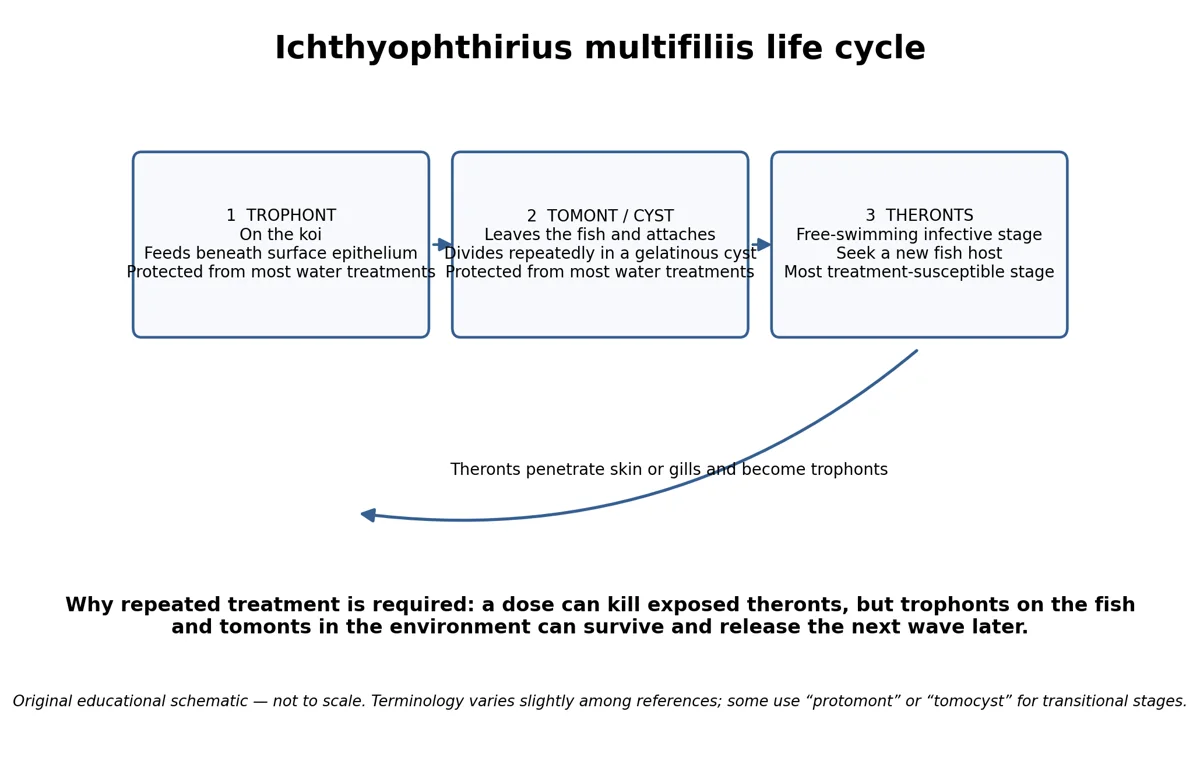
Figure 1. Original schematic of the Ich life cycle. The free-swimming theront is the main treatment-susceptible stage; trophonts and encysted tomonts are protected.
A mature trophont eventually leaves the fish. It then settles on a surface and develops into the reproductive cyst. Within that cyst the organism divides repeatedly. When development is complete, large numbers of theronts emerge into the water and search for a fish. If a theront successfully penetrates a koi, it becomes a new trophont and the cycle begins again.
This is why a single dose can appear to work and still fail biologically. The treatment may kill the theronts that are exposed at that moment, while the white dots already on the fish and the cysts already on the pond floor remain. Days later, the next wave emerges. A treatment programme must therefore continue long enough, and be repeated often enough, to catch successive waves when they enter the susceptible free-swimming stage.
4. Temperature changes the speed of the outbreak
Water temperature strongly affects the Ich life cycle. In warm water the cycle is faster; in cooler water it is slower. UF/IFAS guidance states that at roughly 24–26°C (75–79°F), the life cycle can be completed in about three to six days, and treatment is commonly repeated daily for multiple treatments. At approximately 16°C (60°F), the life cycle is slower and treatment intervals are longer.
For koi keepers this has two important consequences. First, a warm pond can deteriorate quickly because new generations appear faster. Second, treatment timing should not be copied from a schedule designed for a very different water temperature. The product label, the active ingredient, water temperature, system volume and fish condition all matter.
Raising temperature simply to 'speed up Ich' is not automatically safe. Warmer water holds less dissolved oxygen, koi metabolism increases, and some medications become more stressful or have narrower safety margins. In tropical systems that are already warm, deliberately heating the water may add risk without adding useful control. The priority is correct treatment timing, adequate oxygen and stable water quality.
5. What Ich looks like on koi
| Observation | What the keeper may notice | Interpretation |
|---|---|---|
| Small white dots on skin or fins | Often described as grains of salt, pin-head spots or tiny blisters | Classic but not always present |
| Flashing or rubbing | Koi rub the flank or gill area against surfaces | Early irritation; not specific to Ich |
| Excess mucus | Skin may look cloudy, grey or slimy | Common with many parasites and chemical irritation |
| Clamped fins and reduced activity | Fish hold fins close to the body or isolate | A general sign of illness |
| Rapid breathing or piping | Gill involvement can be severe | High urgency, especially when several koi are affected |
| Loss of appetite and weakness | Often appears as infection advances | Suggests significant physiological stress |
| Sudden mortality with few skin spots | Possible gill-dominant infection | Do not rule out Ich because the body looks clean |
The classic white spot is usually easiest to see on darker pigment. On white or pale areas of a koi, the contrast may be poor and the nodules can be missed. Likewise, a gill-dominant infection can be visually deceptive. If several koi suddenly breathe hard after a new introduction, microscopy is more valuable than waiting for obvious skin spots to appear.
The number of visible dots does not provide a reliable count of total parasites. Some organisms are on the gills, some are too immature to produce obvious nodules, and some have already left the fish. A fish that suddenly looks 'cleaner' can actually be entering the environmental phase in which many tomonts are preparing the next generation.
6. White spots that are not Ich
A visual diagnosis is risky because several conditions can create pale dots, bumps, plaques or rough white areas. The safest approach is to combine the pattern, the fish's behaviour, the population history and a fresh wet mount.
| Look-alike | Typical clue | How it differs from classic Ich |
|---|---|---|
| Breeding tubercles | Small hard white bumps, especially on the gill covers and leading rays of male pectoral fins; often symmetrical and seasonal | Usually not associated with flashing, excess mucus or respiratory distress |
| Carp pox | Smooth, waxy, candle-wax-like plaques rather than tiny salt-grain dots | Often larger, flatter and more translucent |
| Fungal or water-mould growth | Cottony or fuzzy material on damaged tissue | Filamentous rather than discrete embedded dots |
| Lymphocystis-like viral growths | Irregular cauliflower-like nodules | Larger, persistent growths; microscopic/histologic confirmation may be needed |
| Debris, air bubbles or medication residue | Material sits on the surface and may change after handling or water movement | No parasite visible on wet mount |
| Other external parasites / irritation | Flashing, mucus and clamped fins can look identical before spots are obvious | Microscopy separates Ich from Costia, Chilodonella, Trichodina and flukes |
7. The first rule: check water before blaming the parasite
A confirmed parasite does not make water quality irrelevant. In fact, poor water makes the case harder to treat. Ammonia, nitrite, chlorine, unstable pH and low dissolved oxygen can produce many of the same outward signs and can reduce the koi's ability to tolerate medication.
Before or at the start of treatment, check dissolved oxygen if possible, temperature, pH, KH/alkalinity, total ammonia nitrogen and nitrite. After a recent water change or top-up, check free and total chlorine. Confirm that pumps, air pumps, returns and bottom drains are working as intended. If oxygen is uncertain, increase reliable aeration immediately.
Do not postpone urgent parasite treatment for hours while chasing perfect numbers, but correct a measured environmental danger before adding a chemical that could make it worse. For example, formalin can reduce dissolved oxygen; copper toxicity changes with alkalinity; a large pH correction during treatment can add another physiological shock.
8. Microscopic identification
Ich is one of the easier fish parasites to recognise once a mature trophont is seen. A fresh skin scrape, fin clip or, when respiratory signs justify it, a small gill sample can reveal the organism. The mature trophont is large for a protozoan—typically about 0.5 to 1.0 mm—round to oval, densely covered with cilia and often seen rolling or rotating slowly.
A classic feature is the horseshoe- or C-shaped macronucleus. It may be obvious in a mature organism but not in every specimen, especially less mature stages. The free-swimming theronts are much smaller, more translucent and move rapidly. They can be confused with other motile organisms if the examiner has not also seen the mature trophont.
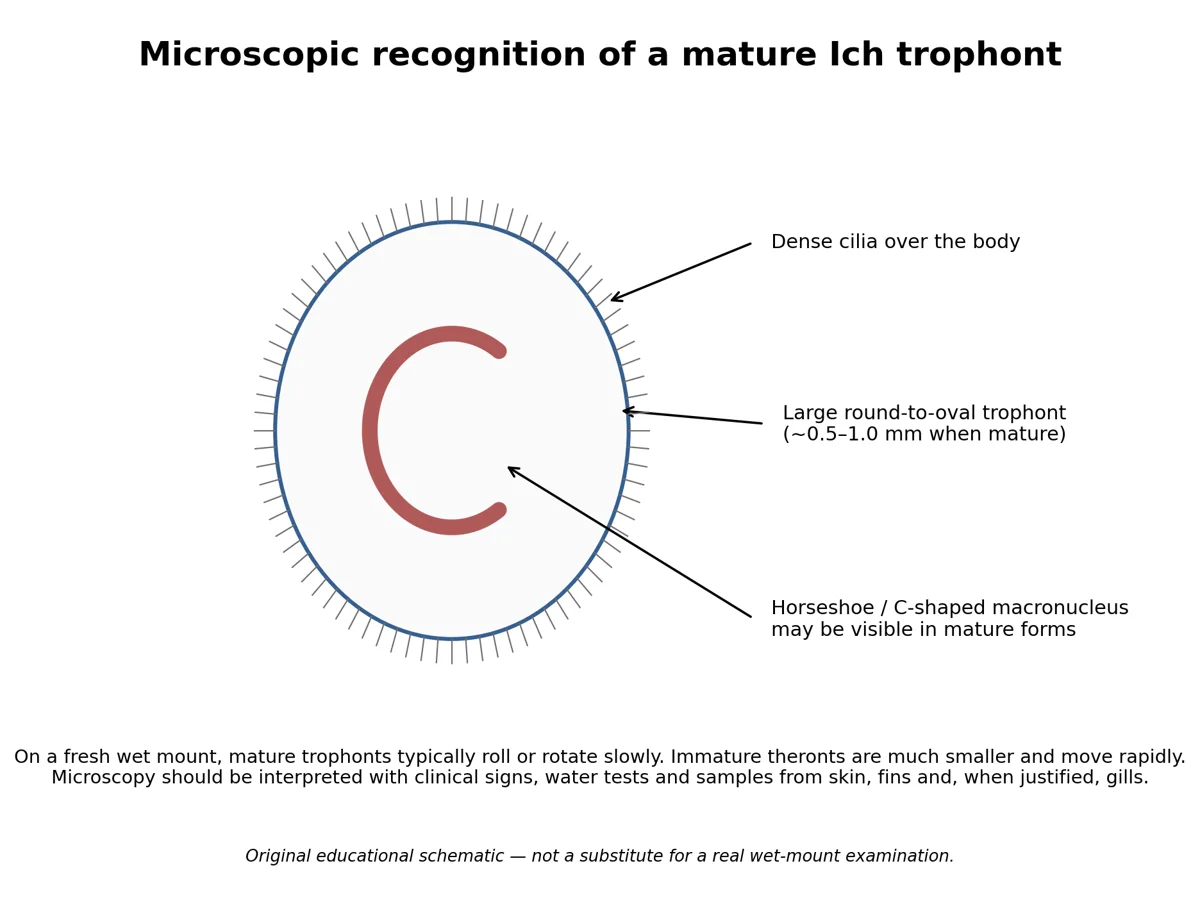
Figure 2. Original educational schematic of a mature Ich trophont. Real wet-mount appearance varies with focus, lighting, parasite maturity and sample quality.
9. How to obtain a useful sample
- Observe the koi before netting. Note breathing rate, flashing, fin position, balance, appetite and whether one fish or many are affected.
- Prepare the microscope, clean slides, coverslips, pond water and handling equipment before catching the fish so the procedure is brief.
- Use a soft wet net and koi sock. Keep the fish wet and well supported; avoid dry hands and towels.
- Take skin mucus from areas where irritation or spots are visible without aggressively scraping damaged tissue.
- A small fin sample can be useful when the spots are prominent on fins.
- If the main sign is severe respiratory distress and skin samples are negative, a competent examiner may need a minimal gill sample. Gill tissue is delicate and sampling can worsen a compromised fish.
- Examine the wet mount immediately in fresh pond or compatible water. Drying or osmotic shock can distort or kill organisms and reduce diagnostic value.
- If no parasite is seen but suspicion remains high, repeat sampling from a different site or another affected koi rather than assuming one negative slide has ruled out Ich.
10. What a positive diagnosis means
For many external organisms, treatment decisions depend partly on burden and fish condition. Ich is different because of its reproductive potential. UF/IFAS guidance recommends treating when even a single Ich organism is confirmed. The practical reason is that today's one visible trophont can become a much larger environmental generation before the next examination.
A positive slide should also trigger a population-level response. Ich is highly contagious through direct exposure to infected fish and through contaminated wet equipment or materials. Treating only the most visibly spotted koi while leaving the rest of the connected system unchanged is usually inadequate.
Stop moving koi, nets, bowls, hoses and water from the affected system into clean systems. If the outbreak is in quarantine, maintain the quarantine barrier. If it is in a sales system, pause transfers until the infection has been brought under control and the fish have been re-examined.
11. Immediate response after Ich is confirmed
- Increase dependable aeration, especially if gills are involved or a treatment that consumes oxygen may be used.
- Confirm the actual system volume. Treatment errors often begin with an incorrect estimate of pond or vat volume.
- Record water temperature because it determines life-cycle speed and influences treatment timing.
- Check pH, KH/alkalinity, ammonia and nitrite; check chlorine when source-water exposure is relevant.
- Choose one evidence-based treatment strategy that is compatible with the fish, system and local product label.
- Plan the full repeated-treatment course before the first dose. Do not stop simply because the visible spots disappear.
- Remove accumulated organic debris where practical without destroying the biofilter or creating a large water-quality swing.
- Use dedicated equipment and maintain quarantine until the outbreak is demonstrably controlled.
12. Treatment principle: target the vulnerable stage repeatedly
The central treatment rule is simple: most water-borne treatments do not reliably kill the trophont protected on the fish or the tomont protected in its cyst. They are most effective against free-swimming theronts. Because theronts do not all emerge at the same moment, treatment must be repeated or maintained long enough to intercept successive waves.
This is why 'the spots disappeared after one treatment' is not a valid stopping rule. Mature trophonts naturally leave the fish as part of the life cycle. The surface may look better precisely when large numbers of tomonts are sitting elsewhere in the system and preparing to divide.
At warm aquarium temperatures, veterinary and aquaculture references commonly describe daily repeat treatments over several days for suitable products. At cooler temperatures the interval is longer because development is slower. Exact schedules must follow the current label or professional protocol for the specific active ingredient. Do not apply one product's frequency to another chemical.
13. Treatment options and safety considerations
| Option | Potential role | Major caution |
|---|---|---|
| Formalin | Effective against free-swimming external protozoa and commonly used in tanks/quarantine systems | Reduces dissolved oxygen; hazardous to handlers; poor-quality or precipitated product is dangerous; vigorous aeration is essential |
| Copper / copper sulfate | Can control Ich in freshwater when correctly calculated | Narrow safety margin; toxicity increases in low alkalinity; can harm invertebrates, algae and fish if misused; not a casual 'guess the dose' treatment |
| Salt / increased salinity | Can be effective in selected freshwater systems and can support osmoregulation | Requires measured salinity, accurate volume and species/system compatibility; plants and some treatments may be incompatible |
| Commercial ornamental-fish products | Some contain combinations such as formalin and malachite-green-type actives | Use only products legal for the setting and follow the current label exactly; combinations can increase toxicity |
| Potassium permanganate | Useful against some external parasites | UF/IFAS specifically discourages it for Ich because control requires frequent repeat exposure and repeated oxidation can damage skin, gills and eyes |
| Heat alone | Faster temperature can shorten the life cycle | Not a dependable stand-alone treatment; warmer water lowers oxygen reserve and can increase treatment stress |
14. Formalin: effective, but oxygen management is non-negotiable
Formalin is a widely recognised external parasiticide and is often used in tank systems for Ich. The problem in koi systems is not merely whether formalin can kill theronts; it is whether the fish can safely tolerate the treatment environment. Formalin chemically reduces dissolved oxygen and can also kill algae, after which decomposition may consume still more oxygen.
For that reason, strong aeration should be running before the treatment begins and throughout exposure. A koi that is already breathing hard from gill damage has less reserve than a normal fish. If fish show marked distress during a treatment, the response should be to follow the product's emergency guidance and restore clean, well-oxygenated water rather than add another chemical.
Formalin is also hazardous to people. It contains formaldehyde and should be handled only with appropriate personal protective equipment and ventilation. Never use a formalin product that has formed a suspicious white precipitate or has been stored improperly. The concentration and exposure time must come from the current product label or an aquatic-health professional—not from a dose copied from an unrelated pond.
15. Copper: effective chemistry with a narrow safety margin
Copper can be effective against Ich, but freshwater copper treatment is strongly influenced by total alkalinity. UF/IFAS guidance warns that copper becomes more toxic to fish as alkalinity falls and advises against copper sulfate when total alkalinity is below about 50 mg/L. Copper can also damage invertebrates and may contribute to oxygen problems when algae die.
For koi keepers, this means copper should not be selected simply because it is inexpensive or because another pond used it successfully. The actual alkalinity, formulation, pond volume and intended copper concentration must be known. A system with unknown alkalinity, uncertain volume or valuable fish is a poor place for improvised copper dosing.
16. Salt: useful in some systems, but not a universal cure
Published aquaculture guidance describes increased salinity as one option for controlling Ich in freshwater fish when the species can tolerate it. UF/IFAS cites prolonged salinity around 4–5 g/L (4–5 ppt) for roughly 7–10 days at warm temperatures as an effective approach in selected smaller systems. This should be treated as a published reference point, not an automatic prescription for every koi pond.
Before using salt, measure the existing salinity with a reliable meter, calculate the true water volume and consider plants, invertebrates, filter biology and other medications. Repeatedly adding salt without accounting for water removed during changes is a common way to overshoot the intended concentration.
Salt should also not be mixed casually with other parasite treatments. Some combinations are compatible and some are not; the correct decision depends on the active ingredients and the product label. If a koi is already in salted water, that fact should be part of the treatment decision from the beginning.
17. Why potassium permanganate is usually a poor choice for Ich
Potassium permanganate is a powerful oxidiser and can be useful for selected external parasite or organic-load problems. Ich, however, requires repeated interception of susceptible stages over a relatively short period. UF/IFAS specifically advises against potassium permanganate for Ich because the frequency that would be required increases the risk of damage to skin, gills and eyes.
This is an important example of why 'stronger' is not the same as 'better.' A treatment must match the biology of the parasite. Repeated oxidation can injure the same epithelial tissues the koi is already trying to repair.
18. Cleaning, filtration and the environmental stage
The tomont attaches to surfaces. In a small quarantine tank, frequent careful removal of debris can physically reduce the number of cysts before they release theronts. This is one reason bare-bottom quarantine systems are easier to manage than heavily decorated tanks.
In a large koi pond, the goal is not to sterilise every surface. Instead, maintain good solids export and avoid allowing heavy accumulations of sludge, uneaten food or organic debris to sit in settlement areas. Clean mechanical stages as needed while protecting mature biological media from unnecessary disinfection.
Do not pressure-wash or sterilise the entire filtration system during an outbreak unless a professional protocol specifically requires it. Destroying the biofilter can replace a parasite problem with ammonia and nitrite poisoning. Mechanical cleaning should reduce environmental parasite load without collapsing biological stability.
19. Can ultraviolet sterilisation cure Ich?
UV can kill or damage organisms that actually pass through the unit at a sufficient dose, and published fish-health literature has discussed UV as a supplementary tool against free-swimming theronts. However, UV does not reach trophonts inside the koi's epithelium and does not kill tomonts attached to pond walls, drains, media or debris.
Therefore UV should be considered a support measure, not a stand-alone cure. Its effectiveness depends on real flow rate, lamp output, sleeve cleanliness and exposure dose. A small UV installed for green-water control should not be assumed to be delivering a parasite-control dose.
If a system is already equipped with a correctly sized UV, keep it maintained and operating unless the medication label requires otherwise. Do not delay proven treatment while waiting for UV alone to 'clear' the outbreak.
20. Quarantine and biosecurity
Ich is easily moved with fish, water and wet equipment. New koi are a common route of introduction, especially when several sources are combined. Quarantine should be a genuinely separate system with dedicated nets, bowls, socks, hoses and test equipment.
Plants, decorations and other wet materials that have been exposed to infected fish can carry environmental stages. Likewise, shared splashes and water movement between adjacent vats can defeat a quarantine programme. If one vat is positive, review exactly how staff move between systems, not only where the fish are housed.
Surviving fish may develop a degree of immunity and may carry a low-level infection without obvious signs. That is another reason a fish that 'looks fine now' should not be moved immediately into an unexposed collection. Re-examination, an appropriate observation period and a complete treatment course are more reliable than appearance alone.
21. Warm tropical and Malaysian koi systems
Malaysia's warm water speeds the Ich life cycle and can make outbreaks move quickly through a densely stocked system. At the same time, warm water holds less oxygen than cool water, so the safety margin during treatment may be smaller—particularly in dealer vats with heavy biomass.
This combination makes oxygen management central. Increase aeration before treatment, verify that air pumps are actually producing flow, and consider backup aeration for power interruptions. A treatment plan that is chemically correct can still fail if the fish are hypoxic.
Heavy rainfall can complicate the picture by changing temperature, pH and alkalinity or by increasing organic runoff. Do not attribute every outbreak after rain to 'cold stress.' Test the water, review recent introductions and confirm the parasite under the microscope.
For imported koi, examine the group after transport rather than treating every shipment blindly. Transport itself can cause flashing, mucus and clamped fins, while prophylactic chemical stacking can damage gills and obscure microscopy. Once Ich is confirmed, however, delay is risky because the warm system allows rapid multiplication.
22. Why treatment fails
| Reason for failure | What happened | Better response |
|---|---|---|
| Only one dose was given | Theronts present at that moment were killed, but trophonts and tomonts survived | Continue the full temperature-appropriate repeat schedule |
| Treatment stopped when spots disappeared | Mature trophonts naturally left the fish | Treat through successive emergence waves and recheck |
| Pond volume was guessed | Dose was too low to work or high enough to injure koi | Measure or calculate true system volume |
| Aeration was inadequate | Gill damage plus medication stress caused hypoxia | Maximise reliable oxygen before and during treatment |
| The diagnosis was wrong | Breeding tubercles, carp pox or another parasite was mistaken for Ich | Confirm with fresh microscopy |
| Water chemistry made the drug unsafe or ineffective | Copper risk changed with alkalinity; organics altered some treatments | Test water and follow active-ingredient-specific guidance |
| Untreated connected systems re-seeded infection | Nets, water or fish movement carried the parasite back | Strengthen biosecurity and treat epidemiologically linked populations |
23. Secondary infections after Ich
Ich damages the epithelial barrier. After a significant outbreak, koi may develop bacterial dermatitis, fin damage or ulcers even after the parasite itself is controlled. Do not assume every red area after treatment means the parasite is still present, and do not automatically add antibiotics to the pond.
Recheck water quality and perform microscopy if signs continue. Progressive ulcers, swelling, pop-eye, haemorrhage, anorexia or continued deaths justify veterinary or laboratory support. Bacterial culture and susceptibility testing are preferable when systemic bacterial disease is suspected in valuable koi.
The most important recovery conditions are stable, oxygen-rich water, controlled organic load, minimal handling and adequate nutrition once appetite returns. Overtreating damaged skin with repeated chemicals can prolong healing.
24. Practical scenarios
Scenario 1: a newly imported koi develops salt-grain spots
Two days after arrival, one koi begins flashing and shows multiple discrete white dots on the fins and dark body areas. A skin wet mount shows a large rotating ciliate with a horseshoe-shaped macronucleus.
Treat this as confirmed Ich. Increase aeration, stop transfers, check water chemistry and apply a full repeated treatment protocol appropriate to the active ingredient and temperature. Do not wait for the other koi to develop visible spots before considering them exposed.
Scenario 2: the spots vanish after the first treatment
The fish looks dramatically better the next morning, so the keeper considers ending treatment.
This is a classic trap. The parasites may simply have matured and left the fish. Encysted tomonts can now be dividing on system surfaces. Continue the planned course and monitor microscopy, behaviour and water quality rather than using skin appearance as the stopping rule.
Scenario 3: several koi gasp but no white spots are visible
A quarantine vat develops heavy breathing and piping after new fish were added. The bodies look clean.
Check oxygen and water first, then examine skin and gills. A gill-dominant Ich infection can cause severe respiratory disease without obvious body spots. Do not rule out Ich on appearance alone.
Scenario 4: white bumps on a male koi's pectoral fins
A mature male in breeding condition shows small rough white bumps arranged along the leading pectoral rays and gill covers. He is active, breathing normally and the other fish are unaffected.
Breeding tubercles are a stronger visual possibility than Ich. Do not medicate from the photograph alone. If there is any doubt—especially if flashing, mucus or respiratory signs are present—confirm with a wet mount.
25. Common myths
'If the dots are gone, the Ich is gone.' False. Spots can disappear when trophonts leave the fish, while reproductive cysts remain in the environment.
'One strong treatment is better than several controlled treatments.' False. The biology of the parasite requires exposure of successive theront waves; excessive single-dose treatment can injure koi.
'Ich only affects the skin.' False. Gill infection can be the most dangerous form and may occur with few visible spots.
'Raising the temperature cures white spot.' Not reliably. Heat changes life-cycle speed but also lowers oxygen reserve and does not replace an effective treatment protocol.
'Any white bump on a koi is Ich.' False. Breeding tubercles, carp pox, fungal growth and other lesions can resemble white spot.
'Salt is always the safest treatment.' False. Salinity must be measured, the concentration must suit the system, and compatibility with plants and medications must be checked.
'UV means I do not need to treat.' False. UV only affects organisms passing through the unit and cannot reach protected stages on fish or surfaces.
26. A keeper's checklist
- How many koi are affected, and did the problem begin after a new introduction?
- Are the spots true embedded white nodules or could they be waxy plaques, tubercles, debris or fungal growth?
- Are fish flashing, clamping fins, producing excess mucus or breathing abnormally?
- What are the current dissolved oxygen, temperature, pH, KH/alkalinity, ammonia and nitrite readings?
- Has free or total chlorine exposure occurred after a water change or top-up?
- Was Ich confirmed on a fresh wet mount from skin, fin or gill?
- What is the actual system volume and current salinity?
- Which active ingredient will be used, and is it compatible with the fish, water chemistry and current treatments?
- What repeat schedule is required at the current water temperature?
- Is aeration strong enough for the whole treatment period, including overnight?
- Are nets, bowls, hoses and water completely separated from unaffected systems?
- Have visible spots disappeared only, or has the full treatment course been completed and the group clinically rechecked?
27. Frequently asked questions
Can Ich kill koi?
Yes. Heavy infections, especially in the gills, can cause rapid and sometimes catastrophic losses.
Can a koi have Ich without white spots?
Yes. Gill-dominant infection may produce respiratory distress without obvious skin spots.
How fast does Ich spread?
In warm water the life cycle can be completed in only a few days, and one tomont can produce hundreds of infective offspring. Crowded systems can therefore deteriorate quickly.
Should I treat the whole pond or only the fish with spots?
If fish share the same water, treat the epidemiologically connected system rather than assuming only the visibly spotted fish is exposed. The exact method depends on the medication and system.
How long should treatment continue?
Long enough to expose successive free-swimming theront waves. The schedule depends on temperature and active ingredient, so follow the current product label or a fish-health protocol rather than a fixed universal number of days.
Can I use salt and formalin together?
Some published protocols combine increased salinity with formalin, but compatibility depends on the exact products and concentrations. Do not combine treatments unless the label or a qualified professional supports it.
Why did the spots get worse after treatment started?
Protected trophonts may continue maturing even while free-swimming theronts are being killed. Visible disease can therefore lag behind effective control. Continued worsening, respiratory distress or deaths still require reassessment.
Can Ich live without fish forever?
No. It is an obligate parasite and its infective theronts must find a live fish within a limited time. How long environmental stages persist depends strongly on temperature.
Can healthy-looking survivors spread Ich?
Potentially. Survivors can develop partial immunity and may carry low-level infection, which is why movement decisions should not be based on appearance alone.
Do I need a microscope?
For a valuable collection, microscopy is strongly recommended. White spots have important look-alikes and the same parasite may be present in the gills without obvious dots.
28. Practical conclusion
White spot disease is dangerous not because the parasite is mysterious, but because its biology allows a small confirmed infection to become a large outbreak very quickly. The visible white dots represent only the on-fish trophont stage. The reproductive tomont in the environment and the free-swimming theront determine whether treatment succeeds.
The reliable approach is therefore systematic: confirm the parasite, protect oxygen, test the water, stop cross-contamination, know the true system volume, select one compatible treatment and continue it on a temperature-appropriate schedule long enough to intercept successive theront waves. Do not stop because the spots have disappeared, and do not stack chemicals in an attempt to make the fish look clean faster.
For koi dealers and serious hobbyists, the most valuable prevention is equally systematic: genuine quarantine, dedicated equipment, routine microscopy, strong aeration and accurate records. When Ich is recognised early and treated according to its life cycle, control is far more achievable than when action begins only after widespread respiratory distress or mortality.
Editorial and safety note
This article is an original educational synthesis for koi keepers and dealers. It does not replace examination by an aquatic veterinarian or qualified fish-health professional. Medication labels, legal uses and product formulations vary by country and can change. Treatment safety depends on active ingredient, concentration, true water volume, temperature, pH, alkalinity, salinity, dissolved oxygen, organic load, fish condition and concurrent treatments. Never mix pond medications unless compatibility is specifically supported by the current product directions or professional advice.
References and further reading
- 1. Francis-Floyd R, Yanong RPE, Pouder DB. Ichthyophthirius multifiliis (White Spot) Infections in Fish. University of Florida IFAS Extension, FA006/CIR920. Current online edition. https://ask.ifas.ufl.edu/publication/FA006
- 2. Merck Veterinary Manual. Parasitic Diseases of Fish. Section on Ichthyophthirius multifiliis, diagnosis by fresh wet mount and treatment principles. https://www.merckvetmanual.com/exotic-and-laboratory-animals/aquarium-fish/parasitic-diseases-of-fish
- 3. MSD Veterinary Manual. Disorders and Diseases of Fish. Overview of freshwater white spot disease and the need for microscopic confirmation. https://www.msdvetmanual.com/all-other-pets/fish/disorders-and-diseases-of-fish
- 4. Francis-Floyd R, Pouder DB. Use of Formalin to Control Fish Parasites. University of Florida IFAS Extension, VM061. https://ask.ifas.ufl.edu/publication/VM061
- 5. Watson C, Yanong RPE. Use of Copper in Freshwater Aquaculture and Farm Ponds. University of Florida IFAS Extension, FA008/FA-13; reviewed 2024. https://ask.ifas.ufl.edu/fa008/
- 6. Noga EJ. Fish Disease: Diagnosis and Treatment. 2nd ed. Wiley-Blackwell. 2010.
- 7. Woo PTK, Buchmann K, editors. Fish Parasites: Pathobiology and Protection. CABI. Background on Ichthyophthirius biology, host response and parasite control.
- 8. Timmons MB, Ebeling JM. Recirculating Aquaculture. 3rd ed. Ithaca Publishing Company. Water-quality and system-management context for intensive fish systems.